
Pinterest Board
Articles and Publication Search
Studio Thinking: The Real Benefits of Visual Arts Education by Lois Hetland, Ellen Winner, Shirley Veenema, and Kimberly M. Sheridan
This book describes how to make art education more accessible and gives many different methods of teaching arteducation, regardless of age. It teaches practices essential for art teachers to teach their students, regardless
if the students are in elementary school, high school, or college. Each of the authors are accomplished educators
who have worked in either art education or psychology. The book features lots of data and analysis based from the top
art schools. This book also has handy guidelines for studio artists and gives direction and guidance for how to teach art.
The practices described in the book can be used to figure out ways to make contemporary art and art education more accessible
to children. It can also be used to figure out cost-effective methods to teaching art so kids from lower-income backgrounds
are not at a disadvantage.
A Comparative Analysis of Conceptions of Art in Contemporary Studio Art and K-12 Art Education, World War II to Present by Lelde Alida Kalmite
Lelde Alida Kalmite wrote this for her thesis paper during her PhD program at University of Minnesota. She examined howcontemporary art was viewed by the public, educators, and artists towards the end of the twentieth century. Kalmite details
the issues of teaching art in public education and she gives plenty of historical context. She also delves into cultural
differences in art education, comparing how art was taught in the USSR to how it was taught in the United States during
the 1960s and 1970s. Her comparisons show a unique perspective on issues of art education in the present. Her insight
on how multiculturalism affects art education could prove to be a valuable source of information and data to my thesis project.
Inoperative Art Education by Nadine M. Kalin and Daniel T. Barney
This article was written by a pair of art educators and they believe art teachers are forced to change their teaching methodsand rely more on technology to teach art. They are anti-standardization and believe it is a hindrance. It does not allow students
to explore and stresses too much on memorization. Art educators are trying to find ways around imposed policies that are designed
to eliminate inefficiency, error, and excess. The problems outlined in this article can be used to help figure out new ways to
teach art. By figuring out curriculum standards, we can find ways to make art education more interactive and fun while enriching
the learning experience.
Art-Centered Learning Across the Curriculum: Integrating Contemporary Art in the Secondary School Classroom by Julia Marshall and David M. Donahue
This book seeks out to integrate contemporary art in elementary school curriculum. Most art teachers do not use contemporary artas a learning device; rather, they stick to Pop Art and previous art movements. Contemporary art is seen as mysterious by many.
This book has a lot of information about why contemporary art isn't taught very much in public schools and seeks ways to make
it more teachable and accessible for children. It illustrates the importances of art education for young humans. It also stresses
teaching of interdisciplinary works. Imagine if we could get children to not just critically think at an early age, but think conceptually.
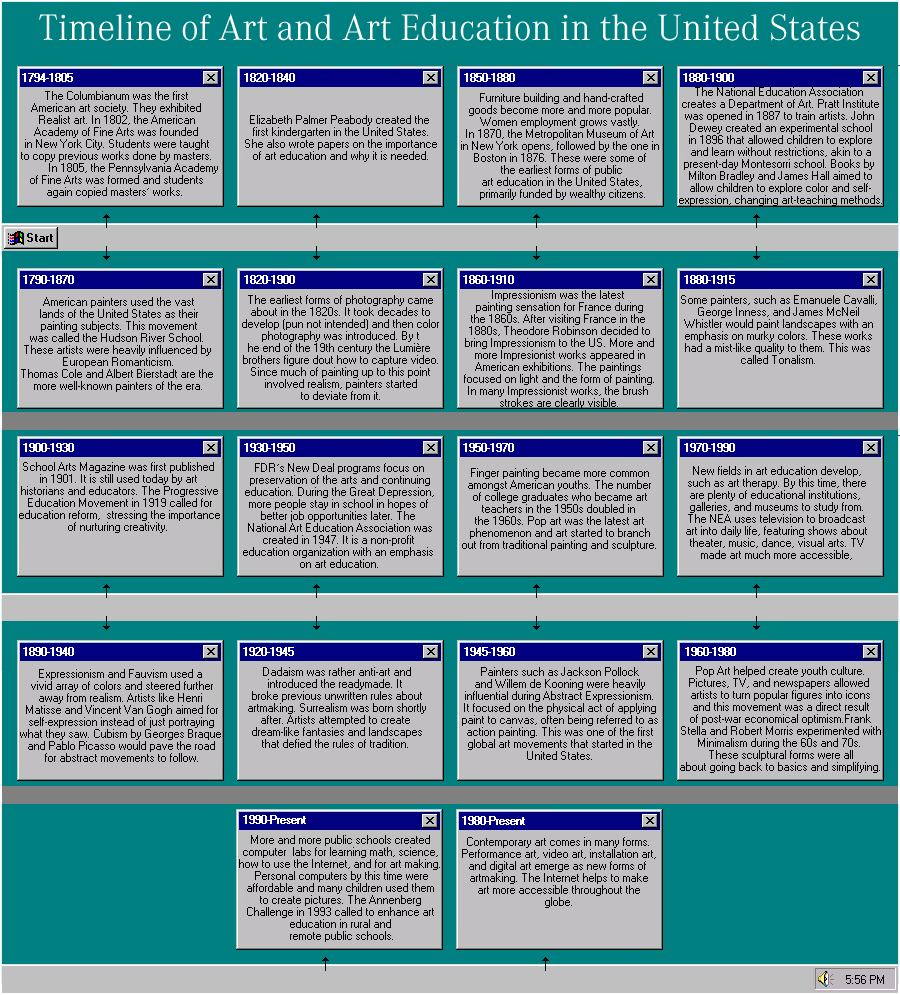
Timeline
Statements
Through exploring how art is taught in present-day schools and conducting research on art curriculum, I shall figure out a new methodof teaching contemporary art to children.
I want to bridge the art education gap between high-income and low-income families. I will gather ideas by studying non-profit organizations
that focus on providing free visual arts education for children of such families and communities.
Children need to learn more about contemporary art and it will improve both their critical and conceptual thinking skills. The current standards
of art education for elementary school children should be restructured to demystify common conceptions of contemporary art as well as
make art more accessible.
Back